
Tallapoosa County Criminal Court Records
The Criminal Division of the Tallapoosa County Circuit Clerk maintains the local trial court file. A criminal case is brought by the State of Alabama through the district attorney or another prosecutor. Once charges are filed, the court record grows beyond the arrest event. It records what the prosecution alleged, what the defendant pleaded, which motions and hearings occurred, how the court ruled, and whether each charge ended in a conviction, dismissal, acquittal, or other disposition.
Circuit Court hears felony prosecutions and related misdemeanors or ordinance violations arising from felonies. District Court handles misdemeanor prosecutions, preliminary felony hearings, and some pre-indictment felony guilty pleas. Alexander City and Dadeville municipal courts hear their city ordinance cases and city-police citations. The Circuit Clerk's criminal record is therefore different from a sheriff booking record and can continue long after a person leaves custody.
The Fifth Judicial Circuit District Attorney prosecutes Tallapoosa County cases. The jury information published by the local court defines the district attorney as the elected official who prosecutes criminal cases and represents a crime victim. For appointed-counsel procedure, an indigent defendant should ask the court at first appearance or arraignment, or contact the Circuit Clerk. No separate county public-defender storefront was verified in the official research.
Search Tallapoosa County Criminal Cases
AlacourtACCESS / Just One Look is the paid statewide portal named by the Tallapoosa Circuit Clerk. It includes criminal trial court records and supports name and case-number searches. Each listed search costs $9.99, including a no-match search. The report can include basic case data, court actions and rulings, status, settings, party details, financial history, the case action summary, and available document images.
- Confirm whether the matter belongs to Circuit Court, District Court, or a municipal court.
- Open AlacourtACCESS and choose a name search or case-number search.
- Use the defendant's legal name or the exact number printed on an official case paper.
- Read each charge beside its plea and final disposition, then review settings, rulings, and sentence entries.
- Request a certified or unavailable document from the Circuit Clerk rather than relying on a screen image.
Direct channels remain available. The Circuit Clerk is in Room 132, 125 N Broadnax Street, Dadeville, and can be reached at (256) 825-1098. Mail goes to the same street address, Dadeville, AL 36853-1371. The published hours are 8:00 a.m. to 5:00 p.m., Monday through Friday. Municipal case users must contact the city court, because a city payment or appearance path is not the same as the statewide case report.
Tallapoosa Criminal Case Stages
The record changes as the case moves. A complaint, information, or indictment identifies the charge. Arraignment records notice of the accusation and a plea. Pretrial entries can show motions, settings, bond issues, discovery disputes, and rulings. A guilty plea, verdict, acquittal, dismissal, or other resolution creates the disposition. Sentencing follows a conviction and may state confinement, probation, restitution, fines, costs, or other conditions.
Case flow: Charges Filed › Arraignment › Pretrial / Motions › Plea or Trial › Disposition › Sentencing
- Charges filed: a complaint, information, or indictment states the alleged offense and starts the court charge path.
- Arraignment: the court informs the defendant of the charges and records a plea.
- Pretrial and motions: settings, motions, rulings, bond matters, and continuances build the case action summary.
- Plea or trial: the defendant may plead, or the case may proceed to a fact finder and verdict.
- Disposition: each charge receives an outcome, such as guilty, acquitted, dismissed, or another recorded result.
- Sentencing: after conviction, the order states punishment and any financial or supervision terms.
What Tallapoosa Criminal Records Show
A criminal case report should be read field by field. The portal's official inventory confirms settings, actions, rulings, parties, status, financial history, the case action summary, and document images or attachments. A public view can omit protected identifiers, juvenile material, sealed filings, victim-sensitive information, and other restricted content. Full field inspection requires paid portal access or a clerk request.
| Field | What It Shows |
|---|---|
| Case Number | The court identifier used for the file and search. |
| Defendant | The accused party, subject to identity redaction rules. |
| Charges | Each filed offense, charging instrument, and later amendment shown in the public record. |
| Bond | Release conditions or financial bond information recorded by the court. |
| Plea | The defendant's response to each charge, such as guilty or not guilty. |
| Settings and Actions | Hearings, trial dates, motions, continuances, and court rulings. |
| Disposition | The outcome of each charge, which may differ within one case. |
| Sentence | Confinement, probation, restitution, fines, costs, or other ordered terms after conviction. |
Tallapoosa Charges vs Convictions
A charge is a formal accusation. It is not proof that the person committed the offense. A conviction follows a guilty plea or guilty finding. One case can contain several charges with different outcomes: one may be amended, another dismissed, and another resolved by plea or verdict. The closer look at the arrest-to-filing path appears in Tallapoosa County arrest records and court charges, while this criminal case file supplies the later plea, disposition, and sentence.
| Charge | Conviction | |
|---|---|---|
| Stage | Accusation | Verdict or plea |
| Burden of Proof | Probable cause | Beyond reasonable doubt |
| Possible result | Amended, dismissed, no-billed, acquitted, or convicted | Sentence and judgment follow |
| How to verify | Read the charge status and later entries | Find the final disposition and sentence |
Read Tallapoosa Case Outcomes
Disposition means the recorded outcome. Guilty indicates a conviction by plea or finding. Not guilty means an acquittal, while dismissed means the charge ended without a conviction through dismissal. A pending status means the case has not reached a final recorded result. A transferred or appealed status points to further action elsewhere. Alacourt's public landing page does not publish an official Tallapoosa status-code list, so abbreviations should be confirmed from the report or clerk rather than guessed.
The sentence must be tied to the charge that produced the conviction. Read confinement, suspended time, probation, restitution, fines, costs, and compliance conditions as separate parts of the order. Bond is a release condition before outcome and is not a sentence. A financial history can mix bond, fines, costs, restitution, and payments, which should not be treated as one number without the underlying order.
Sealed and Expunged Tallapoosa Records
Sealing restricts public access under a statute or court order. Expungement is a court process for qualifying criminal records and is not completed by a phone request to the clerk or sheriff. Eligibility depends on the charge, outcome, and Alabama law. A Tallapoosa County petition is filed in the criminal division of Circuit Court when the qualifying charge was filed in the county.
| Sealed | Expunged | |
|---|---|---|
| Visibility | Closed to ordinary public access as the law or order directs | Removed or restricted from public view under the expungement order |
| Government access | Access may remain for legally authorized users | Some court or law-enforcement access can remain where Alabama law permits |
| Basis | Confidentiality law or a sealing order | Eligibility, petition, required records, notice, and a court order |
The assigned image from Alabama Code Section 15-27-2 shows the felony expungement petition source.
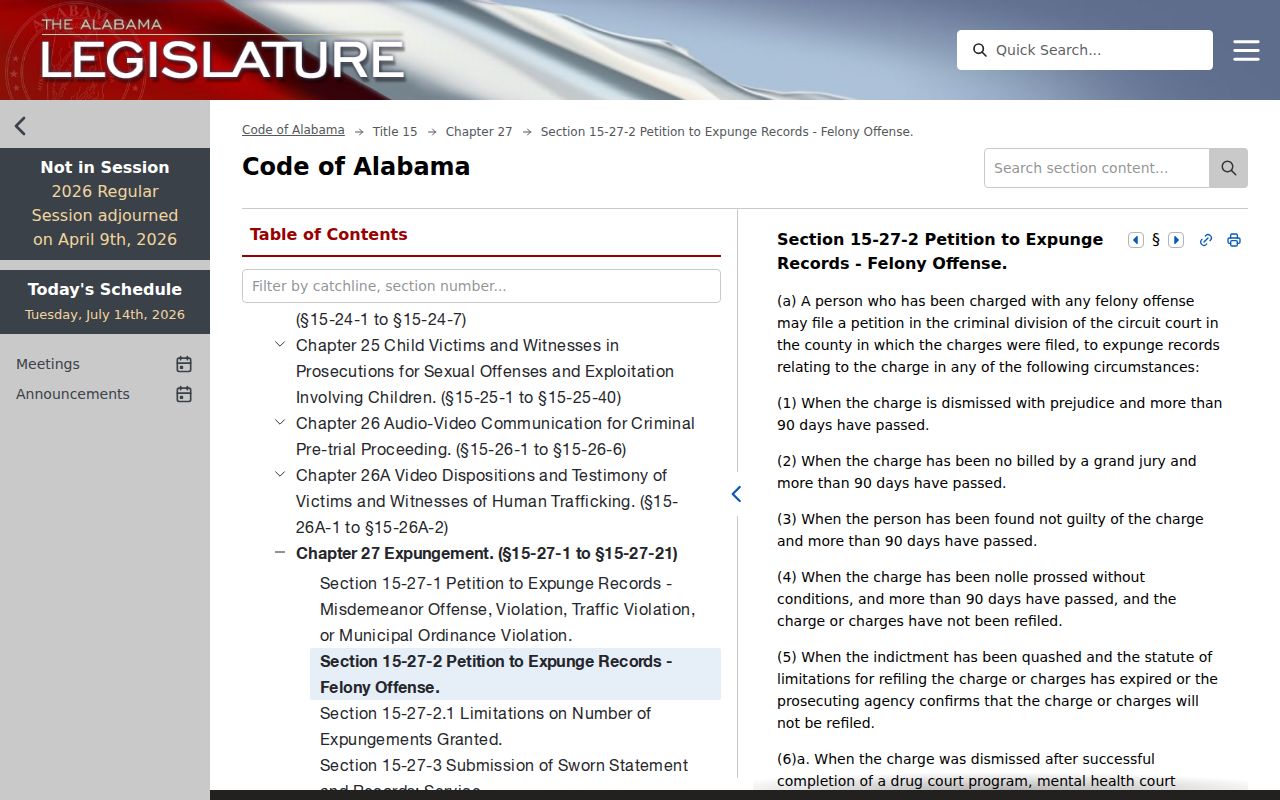
This statute supports filing in the criminal division of the circuit court where the charge was filed, subject to its eligibility rules.
Alabama Code Section 15-27-3 supplies the petition-content source shown next.
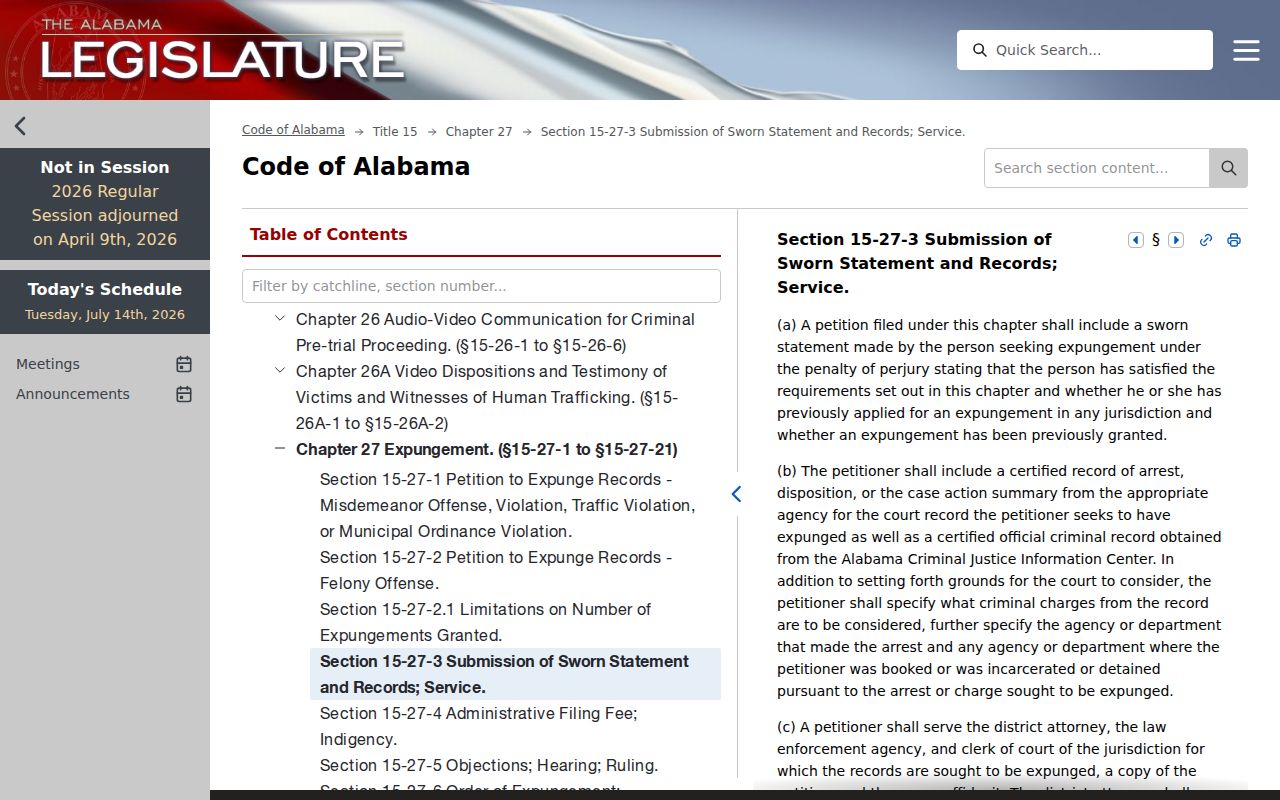
The image reinforces that expungement requires a formal sworn filing and supporting records, not an informal deletion request.
The result of an order is addressed by Alabama Code Section 15-27-6.
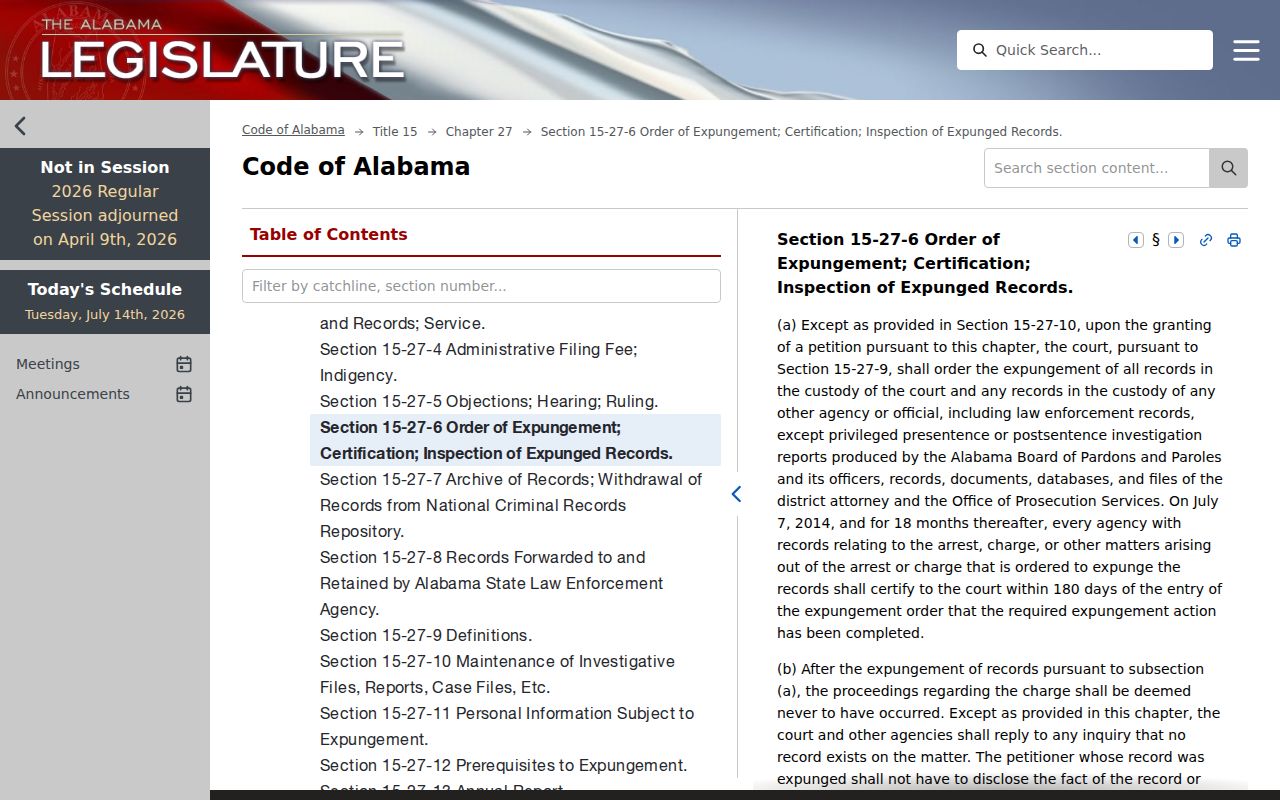
This final expungement image connects the court's order with the later handling of records by the agencies that hold them.
Tallapoosa Criminal Record Access
Adult criminal case files are generally accessible when not sealed, expunged, confidential, or restricted. Alabama Code Section 36-12-40 states the public-record inspection right, while court copies and certified copies also follow Alabama Rule of Judicial Administration 30. Paid online access is not a promise that every historical file or protected attachment is visible.
Key Statutes:
Alabama Code § 36-12-41 addresses copies of public records and payment of fees.
Alabama Code § 12-15-133 makes juvenile court records confidential.
A certified copy comes from the Circuit Clerk. A portal image or screenshot is not clerk certification. Ask the office for the current method, search detail, and fee when the document must be used in another proceeding.
Criminal Records and Identity Checks
A name match can belong to another person. Verify the court, case number, party details, charge, disposition, and sentence before drawing a conclusion. A court case search is also different from a statewide identity-based criminal-history product. Employment, housing, credit, insurance, and other regulated decisions require a lawful consumer-reporting process and appropriate notices, not a casual case lookup.
Important: This privately operated resource is not a consumer reporting agency and cannot supply an FCRA-compliant background report.
Restricted Tallapoosa Criminal Records
Juvenile matters are not ordinary public criminal case files. The juvenile confidentiality statute is shown in an assigned source image.
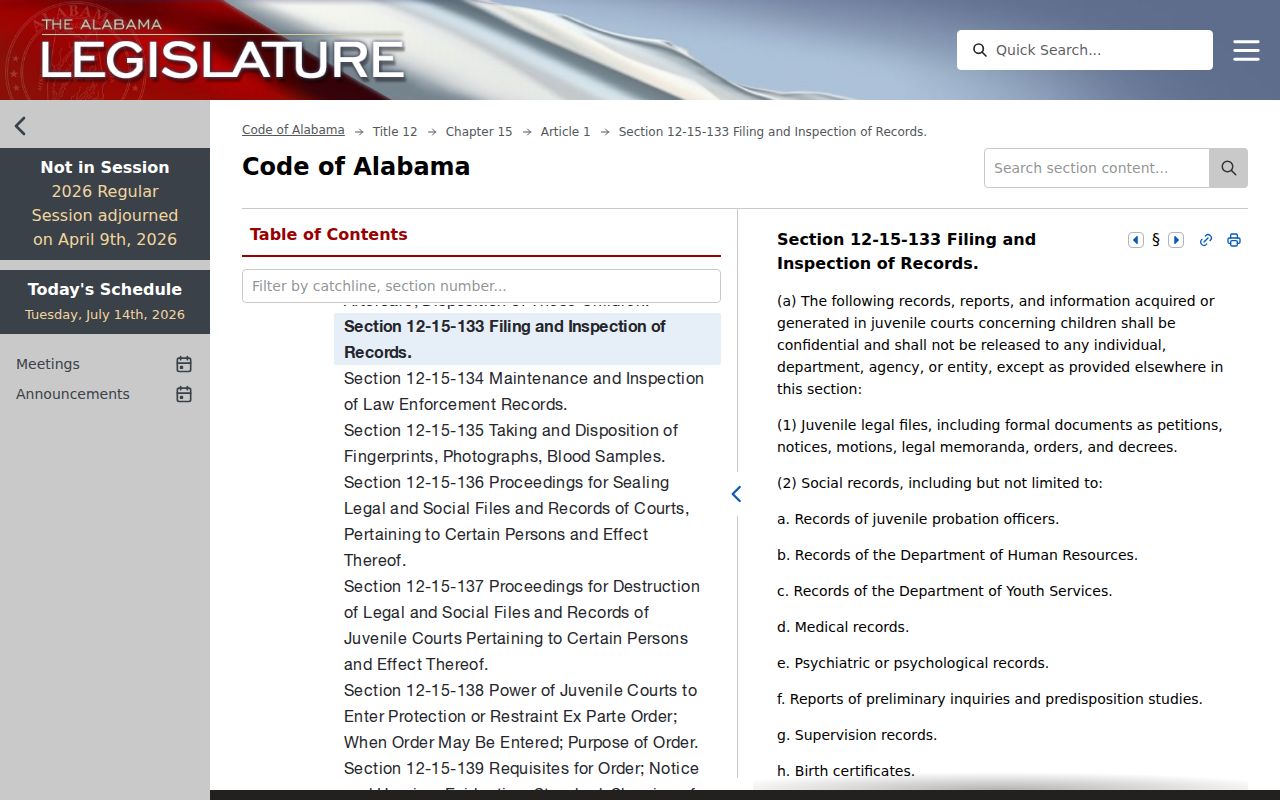
The image illustrates why an adult-record search method should not be applied to a juvenile file or used to promise public access.
Juvenile sealing follows a separate statutory path. The assigned source from Alabama Code Section 12-15-136 addresses that process.
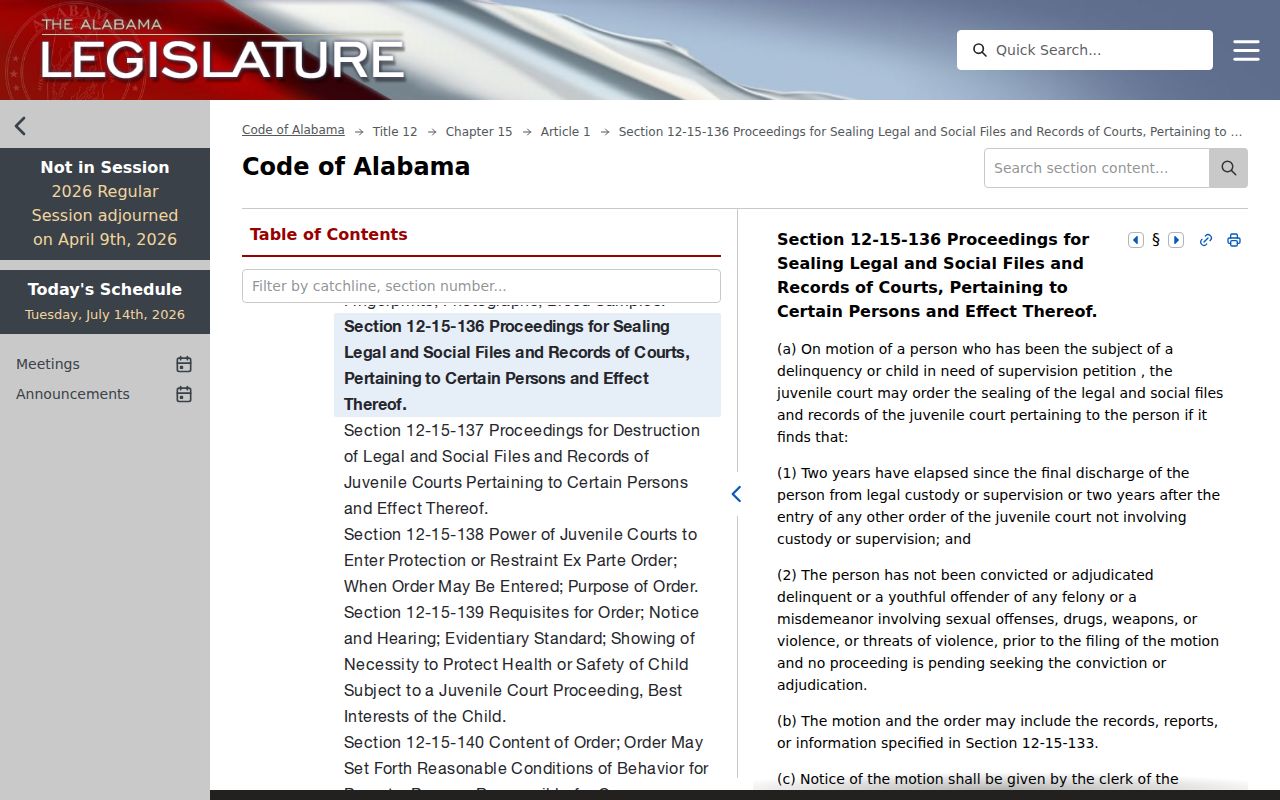
This separate rule means juvenile sealing should not be confused with an adult expungement petition.
Public copies may also redact Social Security numbers, financial accounts, minor identifiers, medical information, victim addresses, and protected attachments. Sealed cases and expunged records do not appear like open adult case files. An online no-match can also reflect a spelling error, a non-digitized file, or the wrong court, so it should not be treated as proof that no case ever existed.